Restraining Order California Lookup provides a clear definition of the protective order issued under California Family Code sections 6201‑6286. A court‑issued injunction bars the named restrained person from contacting, approaching, or threatening the protected party, who may be a victim of domestic violence, civil harassment, elder abuse, or gun‑related risk. The order requires a minimum 100‑foot buffer from the protected person’s home, workplace or school and can mandate surrender of firearms under Penal Code 11393. Violations carry misdemeanor or felony penalties, including fines and imprisonment. All active orders are entered into the California Restraining and Protective Order System (CARPOS), enabling law‑enforcement agencies to verify status statewide.
To locate a specific order, users begin at the clerk’s office of the superior court where the filing occurred, or they can use the California Judicial Branch’s online portal at courts.ca.gov. The portal accepts a case number, party name, or date range and returns docket entries and the full text of the order. Counties lacking public internet access offer printed copies through self‑help centers after a valid photo ID is presented. Remote Access provides attorneys and authorized parties with secure PDF downloads that include timestamps and digital signatures confirming authenticity. The California Courts Protective Order Repository (CCPOR) links each order to CARPOS, assigning a unique identifier that appears on the order header and assists police during traffic stops or background checks.
Restraining Orders – abuse_selfhelp – California
A restraining order, also referred to as a protective order, is a legal injunction issued by a California court that prohibits a named individual from contacting, approaching, or threatening another person. Under California Family Code sections 6201‑6286, the protected party—often a victim of domestic violence, civil harassment, or elder abuse—receives court‑mandated protection. The restrained individual must stay at least 100 feet away from the protected person’s residence, workplace, or school, and may be ordered to surrender firearms under Penal Code 11393. Violations can result in misdemeanor or felony charges, leading to fines, imprisonment, or both. Courts record each order in the California Restraining and Protective Order System (CARPOS), which allows law‑enforcement agencies to verify the existence of an active order nationwide.
https://www.courts.ca.gov/1260.htm 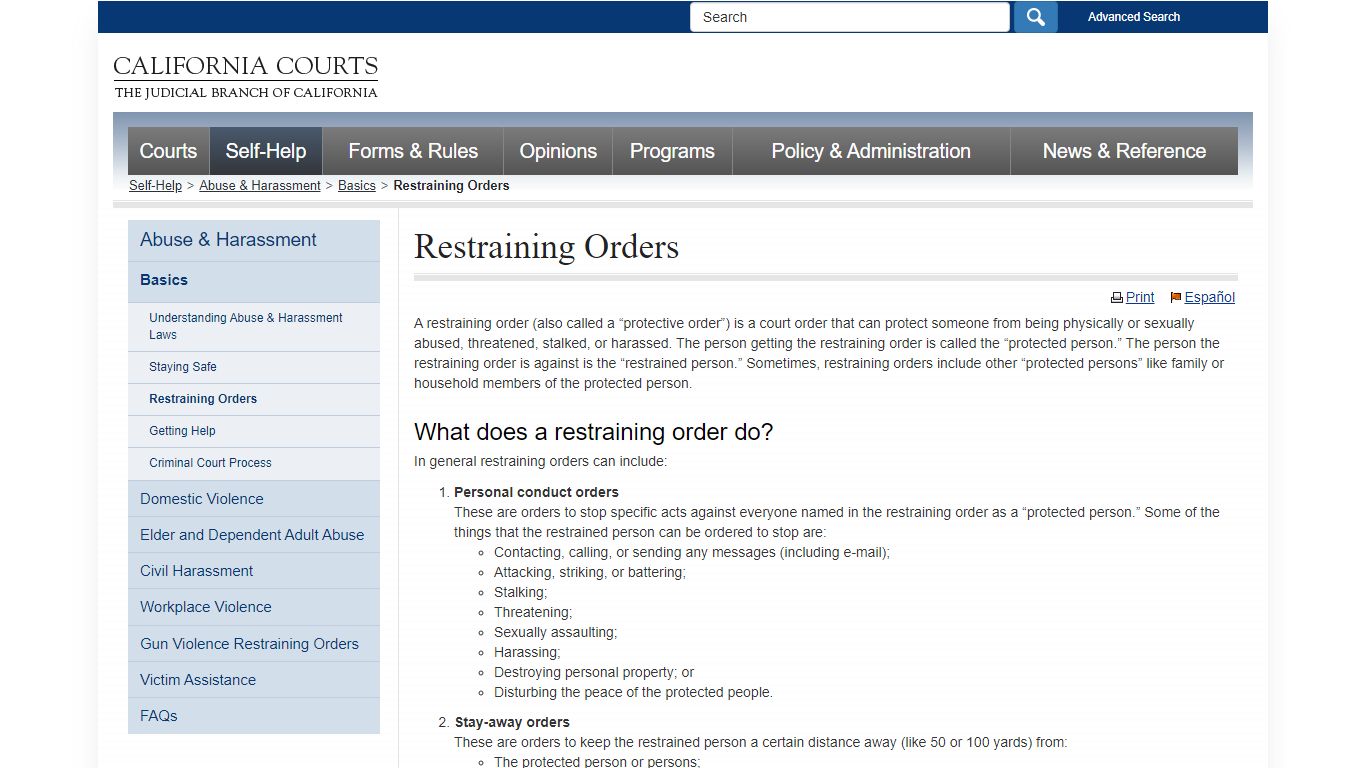
How to Look Up a Restraining Order in California – Her Lawyer
To locate a restraining order in California, begin by visiting the clerk’s office of the superior court where the order was filed; most courts maintain both paper files and searchable electronic databases. The California Judicial Branch’s online portal, accessible at courts.ca.gov, allows users to enter the case number, party name, or date range to retrieve docket entries and the full text of the order. For counties without public internet access, the court’s self‑help center can provide a printed copy on request, typically after presenting a valid photo ID. In addition, the state’s “Remote Access” service permits attorneys and authorized parties to view PDF versions of the order through a secure login, which includes timestamps and digital signatures confirming authenticity. Remember to note the specific restraining order type—civil harassment, domestic violence, elder abuse, or gun violence—because each category follows a distinct filing and service procedure.
https://herlawyer.com/look-up-restraining-order-california/ 
Ask for a Restraining Order – abuse_selfhelp – California
The self‑help center of any California superior court can guide you through the entire filing process for a restraining order, from completing the appropriate forms to preparing for the hearing. First, obtain the “Request for Order” (FL-300) and supplemental affidavits, then carefully answer each question about the incidents, dates, and any evidence such as police reports or medical records. After completing the paperwork, submit the documents to the clerk’s counter; a filing fee of $435 applies, though fee waivers are available for qualifying low‑income applicants. Once the court accepts the filing, you must arrange for “service” of the papers on the restrained person—either through a sheriff’s deputy, a professional process server, or, in limited cases, certified mail with return receipt. Finally, attend the scheduled hearing, bring all original documents and any witnesses, and be prepared to answer the judge’s questions about why protection is necessary.
https://www.courts.ca.gov/1278.htm 
Restraining Orders | Superior Court of California – County of San Francisco
San Francisco’s superior court categorizes restraining orders into four distinct types, each with unique eligibility criteria and procedural steps. A Civil Harassment Restraining Order can be sought by any adult who has experienced stalking, threats, or repeated unwanted contact, and requires proof of at least two separate incidents within six months. The Domestic Violence Restraining Order applies to spouses, former spouses, cohabitants, or intimate partners who have suffered physical injury, sexual assault, or credible threats, and it may include child‑custody provisions under Family Code 6346. Elder or Dependent Adult Abuse Restraining Orders protect seniors (65 or older) and adults with disabilities who face abuse, neglect, or exploitation, and must be filed by the victim, a close relative, or a guardian. Finally, a Gun Violence Restraining Order is issued when a law‑enforcement officer or a close family member demonstrates that the restrained person poses a significant risk of firearm‑related harm, triggering an immediate prohibition on firearm possession under Penal Code 25400.
https://www.sfsuperiorcourt.org/self-help/restrainingorders 
Civil Harassment Restraining Orders | Superior Court of California …
California Welfare & Institutions Code § 15657.03 permits a civil harassment restraining order when an elder (age 65 or older) or a dependent adult (age 18‑64 with a disability that limits daily activities) is the victim of repeated threats, intimidation, or unlawful entry. To qualify, the petitioner must present at least two documented incidents occurring within the previous 12 months, such as police reports, threatening text messages, or eyewitness statements. Once granted, the order can command the restrained party to stay at least 100 feet away from the protected person’s home, workplace, and any locations the protected person frequents. The court may also require the restrained individual to surrender any firearms and to attend a batterer‑intervention program if the harassment involved physical violence. Violations are charged as misdemeanors, and repeat offenders may face felony prosecution under California Penal Code 422.6.
https://www.sdcourt.ca.gov/sdcourt/civil2/civilrestrainingorder 
About CCPOR – California
The California Courts Protective Order Repository (CCPOR) is an integrated software platform that enables judges, clerks, and law‑enforcement officers to view, verify, and reconcile protective orders across the state’s 58 superior courts. By linking each order to the Department of Justice’s CARPOS database, CCPOR reduces the risk of conflicting orders and ensures that a restraining order entered in one county is instantly searchable statewide. The system also assigns a unique identifier to every order, which appears on the order’s header and is used by police during traffic stops or background checks. Implementation began in 2022, with a pilot in Los Angeles and San Diego, and full statewide deployment is scheduled for 2025. Training modules for court staff include data‑entry standards, privacy safeguards under the California Public Records Act, and procedures for updating orders after modifications or terminations.
https://www.courts.ca.gov/partners/ccpor.htm 
Restraining Order – Los Angeles County Superior Court
The Los Angeles County Superior Court provides a self‑help portal where individuals can request a modification or cancellation of an existing restraining order after a hearing before a judge. To start, file a Request for Order (FL‑300) and attach a detailed declaration explaining why the circumstances have changed, such as relocation, reconciliation, or evidence that the threat no longer exists. The court may schedule a status conference, during which both parties can present witnesses, police reports, or counseling records. If the judge determines that the original basis for protection has been resolved, the order can be terminated retroactively to the filing date, or a new order with revised terms can be issued. All filings must be accompanied by a filing fee waiver request if the petitioner’s income falls below the state poverty guidelines, as defined by the California Department of Health Services.
https://selfhelp.lacourt.org/service-catalog/C04 
Access to Electronic Court Records – California
California courts maintain official case files in both paper and electronic formats, and the public can retrieve these records through three primary channels. Visiting the clerk’s office in person allows you to request paper copies of docket entries, pleadings, and protective orders, which are scanned and printed on demand. Many courts also operate on‑site electronic kiosks where visitors can search the case management system using a case number or party name and view PDFs on a monitor. For remote users, the California Courts Online Services portal provides “remote access” to electronic records 24 hours a day; after creating a secure account, users can download the full text of restraining orders, see filing dates, and verify the current status of the order. Some counties charge a nominal per‑page fee for printed copies, while the electronic download service is free of charge.
https://www.courts.ca.gov/42512.htm 
How to Find Out If There Is a Restraining Order Out on Me?
Begin by searching the official website of the county where you suspect a restraining order may have been filed; most county superior courts list a “Protective Order Lookup” tool that accepts the restrained person’s last name or case number. If the online portal does not return results, call the clerk’s office during business hours and ask a staff member to conduct a manual search using your full legal name and date of birth. When requesting a search in person, bring a government‑issued photo ID and be prepared to sign a confidentiality waiver, as protective order information is considered sensitive. Some courts also accept written requests mailed with a self‑addressed stamped envelope, and will return a certified copy of any order that applies to you. If you discover an active order, it is advisable to consult an attorney immediately to discuss options for challenging or modifying the order.
https://legalbeagle.com/5681076-out-restraining-order-out-me.html 
San Diego County Sheriff’s Department
The San Diego Sheriff’s Department operates a public “Restraining/Protective Order Query” website that allows users to verify whether a protective order is currently in effect. The system updates every ten minutes and is temporarily taken offline for maintenance each Wednesday at noon, typically returning to service within half an hour. To conduct a search, enter either the complete case number assigned by the court or the first few letters of the restrained person’s last name; the results display the order type, issuance date, and expiration status. The portal also indicates whether the order includes a firearm prohibition, which is enforceable by local law‑enforcement during traffic stops. For assistance outside of website hours, callers may reach the sheriff’s Records Division at (619) 236‑7075 to request a verbal confirmation.
https://apps.sdsheriff.net/TRO/ 
Restraining Orders: Sacramento Superior Court – California
A Gun Violence Restraining Order (GVRO) in Sacramento can be filed only by an immediate family member—spouse, parent, child, or sibling—or by a law‑enforcement officer who believes the restrained individual poses an imminent threat of firearm‑related harm. The petitioner must submit a sworn declaration, a copy of any police report, and a risk assessment form completed by a qualified mental‑health professional. If the judge issues the GVRO, the restrained party must surrender all firearms and ammunition within 24 hours, and the order remains in effect for up to one year, with the possibility of extension after a hearing. The court provides a detailed worksheet that helps petitioners identify the specific weapons involved, the location of storage, and any known associates who might facilitate access. Legal counsel is strongly recommended, as the consequences of non‑compliance include felony charges under Penal Code 25400.
https://www.saccourt.ca.gov/restraining-orders/restraining-orders.aspx 
Domestic Violence Restraining Order – California
The Sacramento Superior Court’s Self‑Help Center conducts a free Zoom workshop twice weekly to guide individuals through the filing of a Domestic Violence Restraining Order (DVRO). The 90‑minute session includes a step‑by‑step walkthrough of the necessary forms—DV‑250, DV‑210, and a confidential affidavit—plus a live Q&A with a court clerk and a family‑law attorney. Participants who need an interpreter may request a bilingual staff member or enlist a trusted friend to translate; no prior appointment is required, and the workshop begins promptly at 9:00 a.m. on Mondays and Wednesdays, excluding court holidays. After the workshop, attendees receive a digital checklist that outlines the documents to bring to the filing clerk, the fee waiver eligibility criteria, and instructions for serving the order on the restrained party using a sheriff’s deputy or certified process server. Successful filing results in a temporary order that is automatically scheduled for a full hearing within 20 days.
https://saccourt.ca.gov/restraining-orders/domestic-violence.aspx 